
This is a Macchiato Post [Dense with a Touch]:
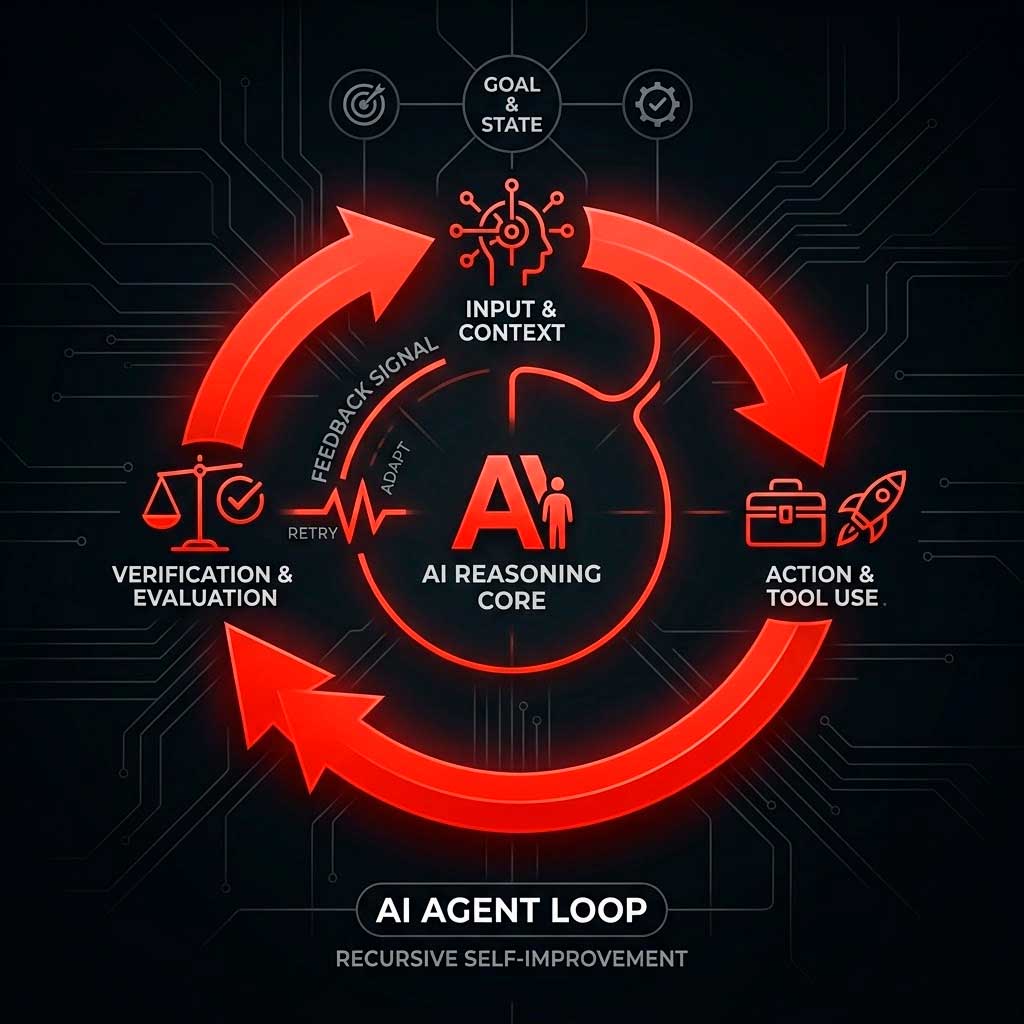
For years, working with AI meant a single exchange: you asked, it answered, and the outcome depended entirely on how well you framed the question. That model is already obsolete for anything beyond drafting or brainstorming. What is emerging now, and what actually matters in production environments, is the AI Loops: a designed cycle where a model can plan, act, check its own output and keep iterating until it reaches a defined goal.
We want to be precise about what this IS NOT. An AI Loop is not autonomy for its own sake, and it is not the “set it and forget it” story that a lot of AI marketing likes to sell. Anyone promising a fully autonomous system that needs no oversight, is selling something else and not engineering. A real Loop is a deliberately bounded cycle: a clear objective, access to specific tools or data, explicit criteria for what counts as done well and a condition that tells the system when to stop. The pattern is simple to state: observe, plan, act, verify, then improve or stop. The value sits entirely in how tightly each of those steps is defined, not in how much freedom the model is given.
This distinction matters because the word “Loop” gets used loosely. A training Loop, where a model predicts, measures its error against known data, and updates its parameters, is a different animal from an agentic Loop, where a system plans a sequence of actions using external tools and inspects the results before deciding what to do next. A verification Loop, where one process generates work and a second, independent process checks it against rules or tests, solves yet another problem: quality control. Confusing these categories is how a business ends up buying “AI Autonomy” when what it actually needed was a data quality check that runs every morning.
Where this becomes useful, in our experience building systems that have to survive contact with a real operation, is in recurring, measurable workflows with contained downside. Take cost management on cloud infrastructure. A Loop can pull billing data weekly, flag unusual spend, compare it against a budget, identify idle resources, and draft a recommendation, all without ever being allowed to terminate a production resource on its own. The system proposes, a person with actual authority decides. That boundary is not a limitation, it is the entire point: cost optimization is valuable precisely because it is recurring and reversible and irreversible actions belong to a human.
The same logic applies to data quality. Instead of an analyst opening five dashboards every morning, a Loop can inspect freshness, schema changes, and reconciliation gaps, generate a hypothesis for the likely cause, open a ticket with the supporting evidence attached and re-check once someone has acted on it. This does not replace the analyst’s judgment, it protects their attention for the exceptions that actually need it, which is a far better use of a scarce and expensive resource than manual monitoring.
Research and competitive intelligence follow the same shape. A Loop can scan a defined set of sources, summarize what changed, and flag claims that need a second look, while a separate step checks whether those claims have credible support before anyone reads the briefing. What that Loop must never be allowed to do is make the actual call on market entry, pricing or which vendor to trust. Collection and synthesis can be delegated. Judgment, the part that carries real consequence, stays with the person accountable for it.
Software delivery is perhaps the clearest illustration, because the pattern of separating the work from its review maps directly onto how good engineering teams already operate. One process implements a bounded change, a second independently runs the tests, checks the linting and verifies the change meets the original criteria. The loop only stops once a reviewer approves, or a limit on time, cost or retries is reached. Nothing here is new in principle. What is new is that both roles, the one producing and the one checking, can now be automated, provided the boundary between them stays intact.
That boundary is really the whole argument. Every Loop that survives contact with a real business needs the same handful of controls: a narrow objective instead of a vague mandate to optimize everything, access limited to trusted and governed data, tool permissions built on least privilege with explicit approval required for anything consequential, verification criteria that do not depend on the model’s own opinion of its work, a hard stopping condition on iterations, cost, or time and full observability into what was done and why. Skip any one of these and you do not have a Loop, you have a liability with a good interface. We have seen enough vendors sell the appearance of intelligence without any of this scaffolding to know that the discipline is where the actual engineering lives, not in the model.
None of this argues against ambition. It argues for sequencing. The right way to build any of this is to start with one workflow that is painful, frequent, and safe to supervise closely, define its output, its data sources, and its stop conditions before touching a single model or agent, and run it in recommendation mode until its accuracy and cost are proven. Only then does limited automation on low-risk tasks make sense. This is also, not coincidentally, the only sequence that works for a small team without a dedicated platform organization behind it: one Loop, done properly, teaches you more than five prototypes running in parallel.
The teams that will get real value out of this shift are not the ones chasing the most autonomous system available. They are the ones building the least autonomous system that still solves the problem, because that is the one a business can actually trust with its money, its data and its time. Deployed correctly, a Loop does not replace judgment. It protects it, by making sure it only gets spent where it matters.