
This is a Macchiato Post [Dense with a Touch]:
The Idea is Simple. What will actually happens, is not. Two CEOs who spent the last year predicting a white collar bloodbath just admitted, within days of each other that they were wrong, and the reasons are awkward. Sam Altman said in Sydney that he was “delighted to be wrong” about entry level jobs disappearing. Dario Amodei, who warned in 2025 that half of white collar work could vanish, is now describing automation as something that multiplies output rather than erasing roles. Both walk backs landed while their companies were closing the two biggest private financings in tech history: Anthropic raised 65 billion dollars in late May at a 965 billion dollar valuation and filed a confidential S-1 days later, and OpenAI is chasing a similar number. It is tempting to read that as pure timing. Fear was a useful story when these companies needed the world to take generative AI seriously. It stopped being useful the moment they needed pension funds and mutual funds to underwrite a trillion dollar listing. Nobody prices an IPO on the promise that the technology might eliminate half its customers’ workforce.
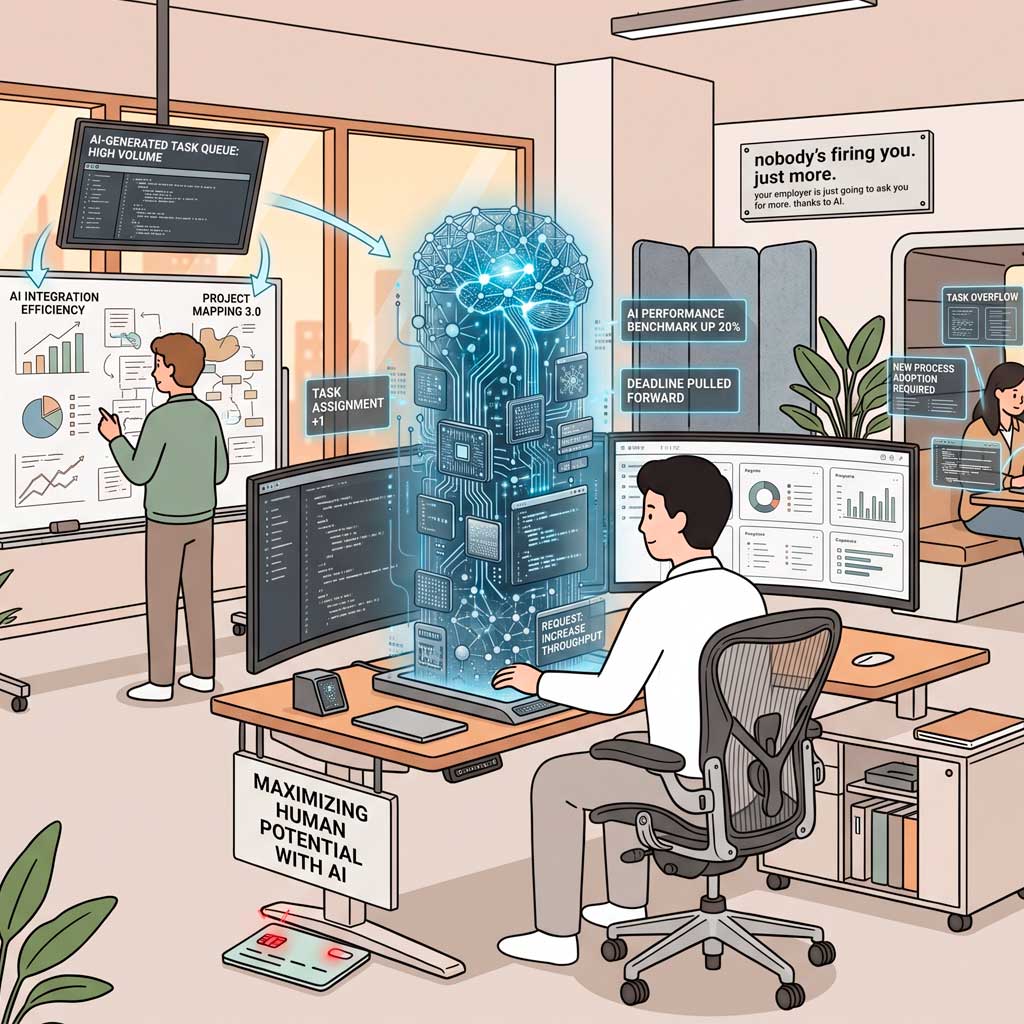
That reading is correct, but it is not the interesting one. The one is a piece of economics that is a hundred and sixty years old. In 1865 a British economist named WILLIAM STANLEY JEVONS noticed something strange about coal: steam engines got more efficient, and Britain did not burn less coal, it burned more, because cheaper energy created uses for energy that did not exist before. He called the idea that efficiency reduces consumption a confusion of ideas. The opposite happened, and it kept happening every time a resource got cheaper to use. Labor is a resource. Amodei, whether he meant to or not, just restated Jevons for knowledge work: automate ninety percent of a job and, in his words, the ten percent kind of expands to be a hundred percent of what people do, at roughly ten times the output. That is not a layoff. It is a re-benchmark, and the data agrees with him. A survey of twelve hundred CEOs from EY-Parthenon found the share expecting AI to cause serious headcount cuts dropped from forty six percent to twenty percent in sixteen months, while eighty percent of those same CEOs are increasing AI spending and forty two percent are redesigning roles instead of eliminating them. Same org chart, a very different idea of what that org chart is supposed to produce by next quarter.
Here is the part almost nobody says out loud when they tell this story with a straight face. Jevons operates on an entire industry, not on any one person inside it. The pie gets bigger. The slices do not redistribute themselves. If AI makes legal work ten times cheaper, the world buys more legal work, which is wonderful news for the partner who already has judgment and client relationships and completely useless news for the first year associate whose entire job was the document review a model now does for free. Growth at the aggregate level and displacement at the individual level are both true at the same time, and that is the sentence the trillion dollar headlines always skip.
If this sounds abstract, Latin America already ran the experiment, twenty years ago, under a different name. The entire premise of the region’s shared services and BPO industry, the medical billing, the claims adjudication, the finance ops and customer support built for clients in the United States and Europe, is that cheaper execution never meant less of it got done. It meant vastly more volume got routed to Bogota, Santiago, San Jose and Guadalajara than would ever have been processed at American labor costs. AI is simply the next drop in that same cost curve, and the mistake would be assuming it plays out the way the doom forecasts predicted, with fewer seats. It will not play out that way. What changes is what those seats are paid to do.
Picture the healthcare billing team that used to spend most of its day keying claims. The keying was always the easiest ninety percent to hand to a model, so it goes first. What survives is the reconciliation nobody automated: the claim denied for a reason the payer’s own rules never clearly explain, the account that does not match because two systems coded the same procedure differently. That work existed the whole time, buried under the typing. Now it is the entire job, at ten times the volume, because the same team can suddenly carry ten times the accounts. The seats survive. The job description from three years ago does not.
That is the real risk for a region whose competitive advantage was never cheap hands, it was reliable execution at scale, at a price nobody else could match. Jevons says demand for that execution is not going away, it is about to multiply, but it multiplies for the people who can supervise, judge and decide, not for the people who can only process. That is a higher bar, and it is coming regardless of whether anyone calls it a jobs apocalypse or not.
So the question everyone keeps asking, whether AI will take their job, was always the wrong one, and the numbers above say so plainly. The better question is what your job turns into, and whether you get to decide what fills the part of it that is about to expand, or someone else decides that for you. Because the bill that is actually coming is not a pink slip. It is a Tuesday where the routine work takes twenty minutes instead of four hours, and the remaining three hours and forty minutes get filled with something. The only open question worth asking is whether that something is the work that actually matters, or just more of the same at a faster clock speed. Just saying…